(Or, any time-based resource management game, to be honest).
Not going to lie here: I have played a lot of Stardew Valley. My current play time sits around 167 hours, which for me is a gigantic amount considering the games I put so much hours in are usually the ones I get a paid salary for. Back in the days of Game Boy and cassettes I played Harvest Moon but not a lot. Stardew Valley was an accessible and fresh revamp of the game type, and I started up a new farm numerous times. It’s a ‘simple’ game in its design: You inherit a farm. Each day you can decide what to do in that day but there is a set number of hours to do it in, and the action choices are many. This inevitably leads to the player committing to time management in order to obtain their goals.
And that, I realized, is where Stardew Valley has great beneficial power as a chore management trainer to impart skills that can translate over into the real world.
What to do in a day?
There are a few things in the game that are part of its ‘core loop’: the foundation rules that repeat continuously and affect player decisions.
1. There are 4 seasons, and each season lasts for 28 days.
2. Each day has a random weather chance. From sunny, to rain, to thunder etc.
3. There are elective actions offered to the player: NPCs that request certain items or things to be done, certain items that have to be gathered for collections, or events on fixed days that can be prepared for in some way.
4. There are events on certain days that lock out certain parts of the map.
There’s not really a right way to play Stardew Valley; there’s a lot of freedom to be had so any way is essentially the right way. But in order to play it the player will generally start to plan their days in a way that takes the above-mentioned core loop actions into account. What crops are they growing in a season? What are they going to try and gather when, in terms of foraged items or fish? Which NPCs do they want to romance or follow the stories of? Again, none of it is really mandatory: You can do a spot of crops growing then move to animal husbandry, or spend most of the time mining and fishing. The player doesn’t have to complete collections or interact with NPCs but it’s generally fun and gives a sense of accomplishment so most players will do so. But there’s not really a penalty for not doing so, keeping the threshold rather low.
Getting a routine
But playing Stardew Valley eventually revolves around some bit of planning. And dealing with unexpected opportunities. Both are unavoidable. It is inherent to the fixed-hours nature of a day, and the occurrence of events and requests (random or not). The player has to plan if they want to achieve a goal that they set.
For example:
If the goal is to spend the next day going to the mines and unlock another elevator then this requires the player to make it through 5 mine floors within a single run. This is because elevators unlock on every 5th level of the mine and are the only entry point. So a player will always start on a ‘5th’ level and then has to dig down to the next ‘5th’ level. Without using items, this usually takes a full day.
A player who did not plan well might start the day with their backpack full of stuff that is unhelpful for the mines and will have to spend time dumping it in a chest before setting off, or land in an tough spot where they have to trash something because they found something really good on a mine floor. They might also not have prepared adequate healing or energy items and either spend time getting that ready, or forget them altogether and run out of energy just short of unlocking a new elevator. For the game neither of these scenarios truly matter: the mines are random generated so with enough tries the player has every chance to re-acquire something. It just takes more time.
But for the player it probably would’ve been a far more enjoyable experience if they didn’t walk off the farm only to double-back realizing their inventory was mostly filled with foraged items they forgot to put in a chest! And it probably would’ve been a far more enjoyable run of the day if they didn’t end up feeling a bit stressed in the mines because they just need 1 more floor to get a new elevator but no stone is yielding a staircase, but their energy is almost ‘exhausted’, and they don’t have food items anymore… oh and it’s nearly 10pm so they should actually think about heading back because get to bed too late and the next day starts with a half-filled energy bar. Which is fixable but then they’d have to spend time and resources fixing it.
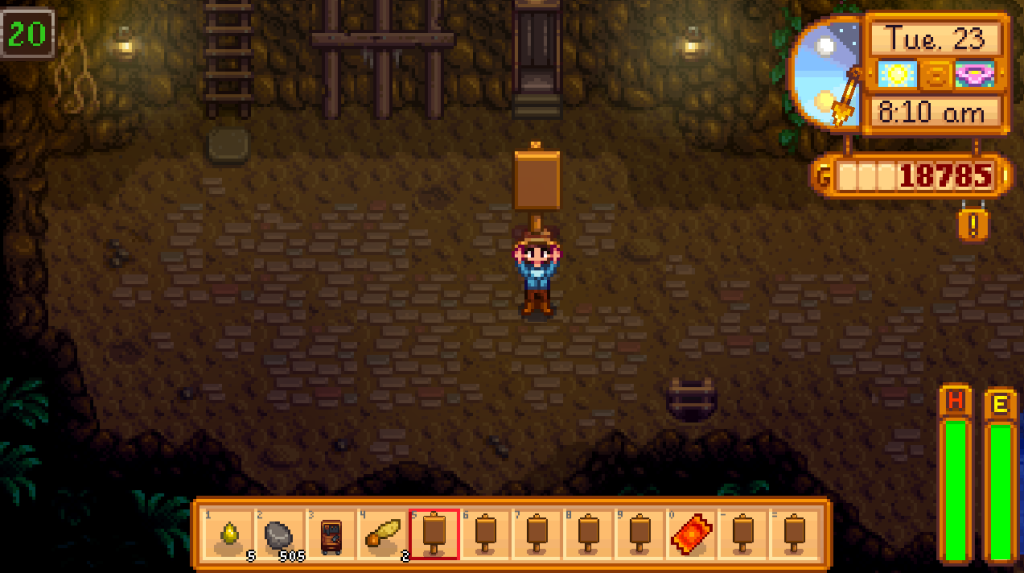
If it wasn’t obvious yet: I’ve been in that specific non-enjoyable situation quite a few times!
But it eventually got better. Because as I stumbled over and over I eventually did remember to dump my stuff before walking off the farm grounds. And I did select food items so I didn’t run out of energy. And then I started preparing those things the day before so that I was ready to go on the day itself! Good habits to develop. But developing good habits takes time, a motivator, and above all: repetition. And that’s where Stardew Valley can really shine. Simply because it has a day cycle short enough to give lots of repetition options, and because the player is choosing to do something they select their own motivator. No-one tells the player they have to go into the mines: they choose to do so.
It builds routine.
It builds habits.
And the feedback makes it really clear to the player that if they tweak their habits just a little if they wanted to, they could benefit more and have a more enjoyable time.
Insert chaos

The element of chaos, when brought into a video game, is a fun thing that really pokes at someone’s character. Chaos is a stressor, and stressors reveal someone’s weak spots. Stardew Valley definitely has chaos elements, although it again proposes it as entirely optional. Sticking to the example of the mines, chaos could insert itself in several ways:
- The game randomly decides for the player to have terrible luck that day, leading to fewer loot drops and a lower chance of finding a ladder down to the next floor (increasing energy expenditure and time cost)
- The game also determines that it’s going to rain on the intended day. If the player did not furnish all of their crops with sprinklers this means they gain extra time for their mining expedition because they don’t have to water any crops.
- The fact that it’s raining presents the player with the opportunity to catch a rare fish that only appears on a rainy day in that season. The player still needs that fish to complete a fishing bundle: Will they forgo the mines to try and get that fish, or will they wait until the next time that fish may appear (it is unknown if this season has another rainy day since the chance is random).
Those are unexpected influences and opportunities that affect planning. They invite fast thinking and mental flexibility from the player. Keyword being ‘invite’ instead of ‘require’ since, again, Stardew Valley doesn’t actually care what the player does in a day. It’s the player’s choice. Stardew Valley just accommodates, whatever the choice will be.
Unexpected opportunities train the mind to be flexible and to consider what is more beneficial in a specific moment, based on how the world introduces other factors. Sometimes that means that little of what you had planned in advance will actually happen on that day. Or you get a burst of energy, take a snapshot decision, and still get all of it done in that day: that’s a great success to feel good about. But if that mining day that you planned for did not go through because you spend time catching that rare fish? Just pick back up where you left the next day. Because that’s also an important part of forming habits: keep coming back to a task. Stardew Valley has a lot of moments where the player can abandon a task, and it’s up to them to come back later.
Why stay in the game?
The more I played Stardew Valley the better I got at planning these activities. Or shelf them for some of those random opportunities, only to continue the plan later. It got easier to plan ahead: driven by cues and seeing opportunities and picking them up as I went. It also got easier to prioritize actions and become flexible in my plans, or just say no to something (I eventually stopped rushing northwards whenever a train was coming by the village).
Then one day it just clicked: I spend so much time doing this in a video game and gotten quite better at this kind of management… but I could also do this in the real world. If I spend just a moment thinking more about what I was doing in a day I could group actions together, or look out for random opportunities that presented itself.
Sure, it’s not that this game taught me anything new. And throughout life this habit gets trained regardless (with various degrees of effectiveness). But I found that because Stardew Valley trains it in such an optional and non-punishing way it sticks way better. Because, again, Stardew Valley does not care if I succeeded my goals.
I care. I don’t need to, but I do have a far more enjoyable time if I just cared a little bit about managing my chores properly. Because, as opposed to Stardew Valley, the real world does care more and it’s simply not always possible to just outright abandon something.
So nowadays when I get groceries I sit down and prepare beforehand to make sure I don’t ‘run out of the house unprepared’. Because in Stardew Valley I’ve run out plenty of times only to spend way more time on thinking about and sorting items, or having to do a 2nd run because I didn’t prepare in advance for what I was going to do and ended up forgetting things. I usually do this preparation in the morning when I’m sitting on the couch drinking coffee and listening to the news in a semi-awake state: the very manifestation of ‘idling’.
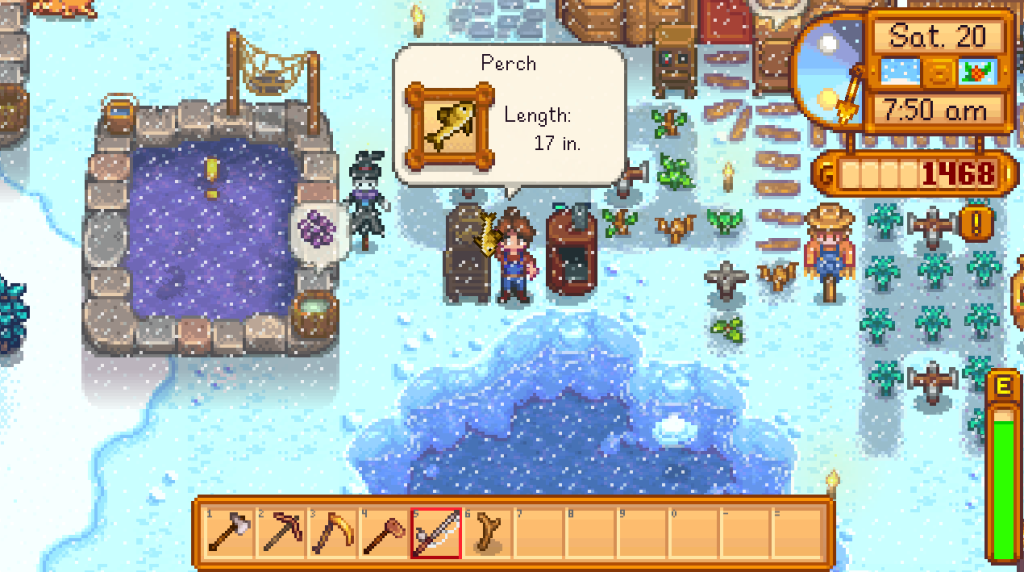
When I go and dedicate myself to cooking dinner I do not walk between the kitchen and the living room to sit down and watch TV or something: I look around the kitchen and take the time to do the dishes and clean the countertops. Because in Stardew Valley I realized that if I put the fish smoker and charcoal kiln next to the water I could fish while waiting for the smoker to finish, so I was optimizing my waiting time spend in a location.
And instead of turning on the TV in Stardew Valley or check the in-game calendar, I check local newspapers to discover there’s an upcoming book promotion at the library, or some other random event somewhere else. And if I feel like it, I might go there. No matter how much of a sudden random opportunity it seems to be.
And when I come home from work I for sure will have thought about whether I need to pick something up from the stores during the drive home and stop by instead of going home first. Because if I’m on the road anyway it is far more efficient to drop into town instead of walking that road between the town and the farm an extra two times!
It might sound odd but it’s definitely because of my hours spend running a pixel-art farm and getting annoyed by my own little bad habits that cost more time than needed that my chore and time management in the real world became a lot better and a lot less stressful.
Because in Stardew Valley: if you don’t get it right on the first try, just try again tomorrow.